
고정각형 로터
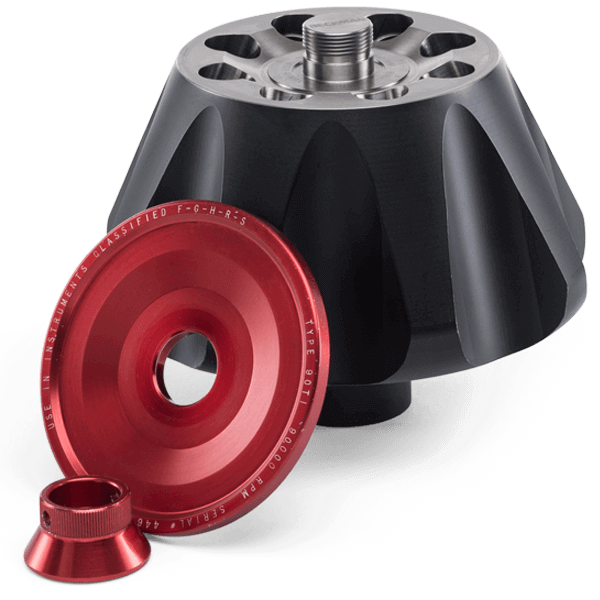
고정각형 로터(Fixed-angle Rotor)는 중간정도의 샘플이동거리(pathlength), 빠른 실행 시간 및 탁월한 해상도를 특징으로 합니다.
고정각형 로터에서, 로터가 회전하는동안 튜브는 일정한 각도로 유지되며, 일반적으로 수직에서 23°– 38° 사이입니다. 이 로터들은 일반적으로 높은 속도에서 볼륨 크기에 관계 없이 펠릿을 회수하고 현탁액에서 미립자를 제거하고 잔해물을 폐기하는 박테리아 및 효모와 같은 펠릿화 작업과 DNA의 등밀도 분류에 사용됩니다.
펠릿화 작업을 할 때 펠릿이 튜브의 바깥 쪽을 향하는 부분에 수집되면 펠렛을 쉽게 회수할 수 있습니다. 고정각형 로터는 펠릿에 대한 편리한 접근성을 확보하려는 경우에 적합합니다.




FAQ on Fixed-Angle Rotors
What are the advantages of a fixed-angle rotor?
Fixed-angle rotors are designed to shorten the distance particles must travel before sedimenting. This can reduce centrifugation times and improve pelleting efficiency. They are frequently selected for cell harvesting, microbial culture processing, nucleic acid isolation, and protein precipitation workflows where fast and reliable separation is important.
What is the difference between a fixed-angle rotor and a swinging-bucket rotor?
In a fixed-angle rotor, tubes remain at a fixed position during centrifugation, making the rotor well suited for rapid pelleting applications. In a swinging-bucket rotor, tubes swing outward to a horizontal position during operation, providing longer sedimentation paths that can improve resolution for density gradient separations. Fixed-angle rotors are typically preferred for pelleting, while swinging-bucket rotors are often selected for separation and gradient-based applications.
What is a fixed-angle rotor?
A fixed-angle rotor is a centrifuge rotor in which sample tubes remain positioned at a constant angle, typically between 20° and 45°, throughout centrifugation. During operation, particles move outward toward the side and bottom of the tube, forming a pellet along the tube wall. Fixed-angle rotors are commonly used when rapid pelleting and high throughput are required.
How do I choose the right fixed-angle rotor?
Selecting the appropriate fixed-angle rotor depends on several factors, including sample volume, desired throughput, maximum speed, required RCF, tube compatibility and separation goals. For demanding applications, evaluating rotor capacity and k factor can help identify the most efficient option for achieving target separation performance.
What is the k factor of a centrifuge rotor and why is it important?
The k factor is a rotor performance parameter that indicates the relative efficiency of a rotor for particle sedimentation. Lower k factor generally correspond to shorter centrifugation times because particles can sediment more quickly. When comparing fixed-angle rotors with similar speed and capacity specifications, the k factor can help determine which rotor may provide more efficient separations for a given application.
Learn More